
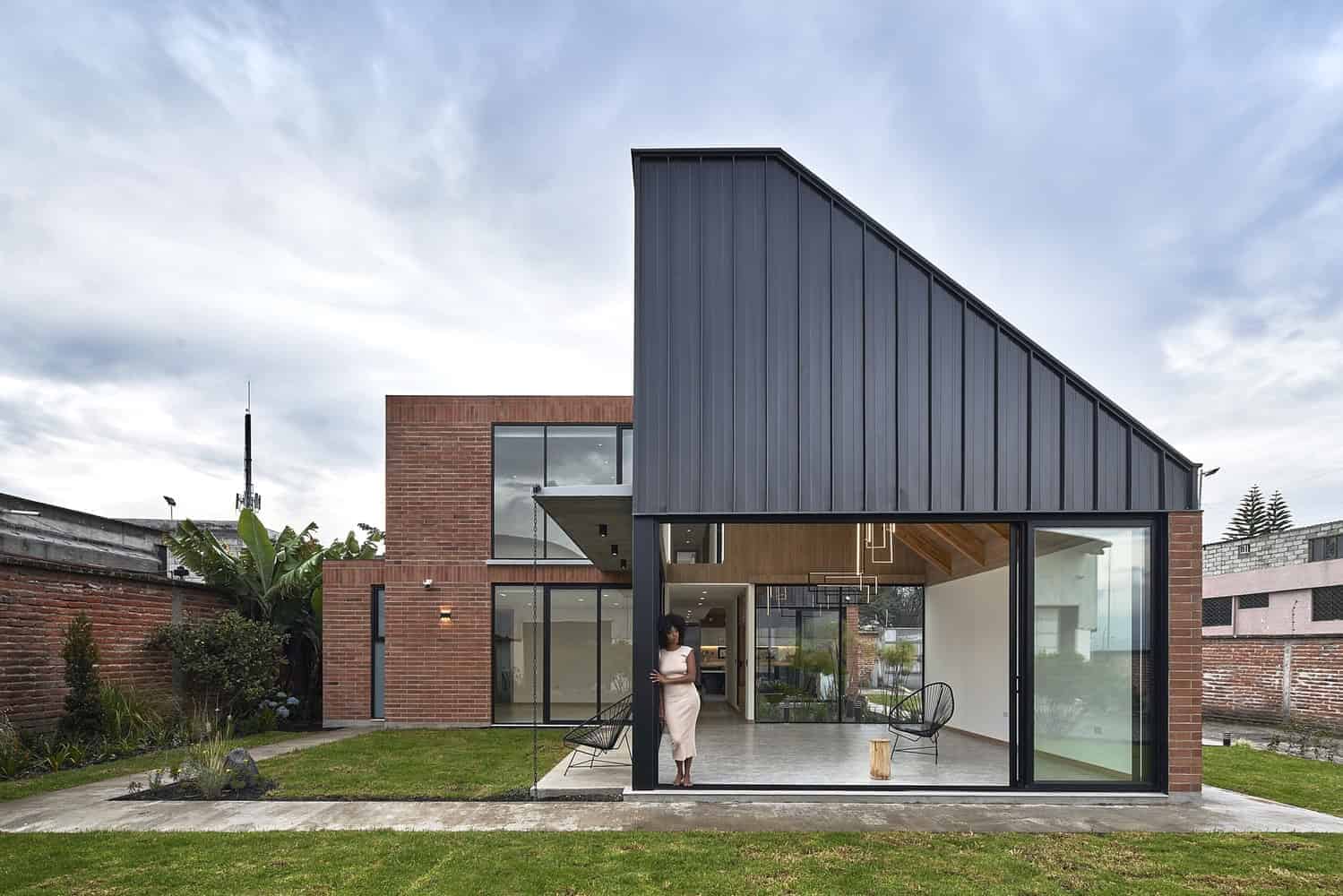
- Project: House Between Gardens
- Architect: TEC Taller EC
- Location: Ecuador, Cumbayá Valley
- Year: 2023
- Area: 280 m2
- Photography: Paolo Caicedo
A Dwelling Composed Like a Landscape and a Game
In the verdant foothills of the Andes, just outside Quito, the House Between Gardens by TEC Taller EC emerges as a refined exploration of space, structure and nature. At 280 m², this residence transforms the traditional house-in-garden typology into a layered sequence of volumes and voids—opening to the landscape, closing to the street, integrating architecture and environment with subtlety and precision.
The home sits on a 760 m² lot in the Cumbayá Valley. The design unfolds as a grid of eight modules, four of which are built solid volumes and four open garden or circulation voids. This chess-board strategy—alternating solid & void—allows the house to stretch spatially across its site, enabling generous daylighting, cross-ventilation and genuine connections to exterior green space.
A central longitudinal axis organizes all movement: on one side, the social living-dining-kitchen zone; on the other, service and private areas. The two “social” volumes rise as double-height spaces with black metal roofs and a semi-solid brick base—they are expressive, sculptural. The private modules remain two-storeys and discreet. Through this sectional articulation, the architecture negotiates scale, intimacy and communal life.
Materiality, Climate & Form
TEC Taller EC chooses a minimal material palette—exposed brick walls, black metal roof cladding, expansive glass—and makes form follow program. The built volumes push toward the green garden spaces; the open modules recede, giving the house both presence and retreat. The brick base provides thermal mass and texture; the dark roof gives a strong silhouette; wide open faces toward courtyards invite light and air.
Performance plays a vital role: the alternating modules and abundant openings create multiple façades toward garden and sky, enabling cross-ventilation and passive comfort in the warm Andean valley climate.
Spatial Experience: Indoor-Outdoor Integration
From the street the house presents a closed, protected façade. Inside, the architecture opens toward garden, sky, and view. The social volume’s double height allows sunlight to cascade down; an open ring of circulation walks you from garden to living space to private retreat with clarity. Each module has its relationship to outdoors. The corridor becomes a journey, the courtyard turns into a room, and the architecture becomes fluid rather than rigid.
Significance & Design Legacy
-
Typological reinvention: By deconstructing the conventional single-family home into modules of built and open spaces, the house becomes flexible, layered and spatially expansive without relying on excess.
-
Material-driven expression: The architecture doesn’t hide structure. The brick, metal roof and exposed volumes speak clearly of their logic and purpose.
-
Climate adaptation: Cross-ventilation, shaded façades, and the layout’s rhythm respond intelligently to its equatorial-Andean context.
-
Landscape integration: Rather than dominate the site, the house weaves through it—gardens, voids and built forms interlace.
House Between Gardens is therefore more than a residence—it is a refined architectural proposition that dialogues with environment, form and living.


