
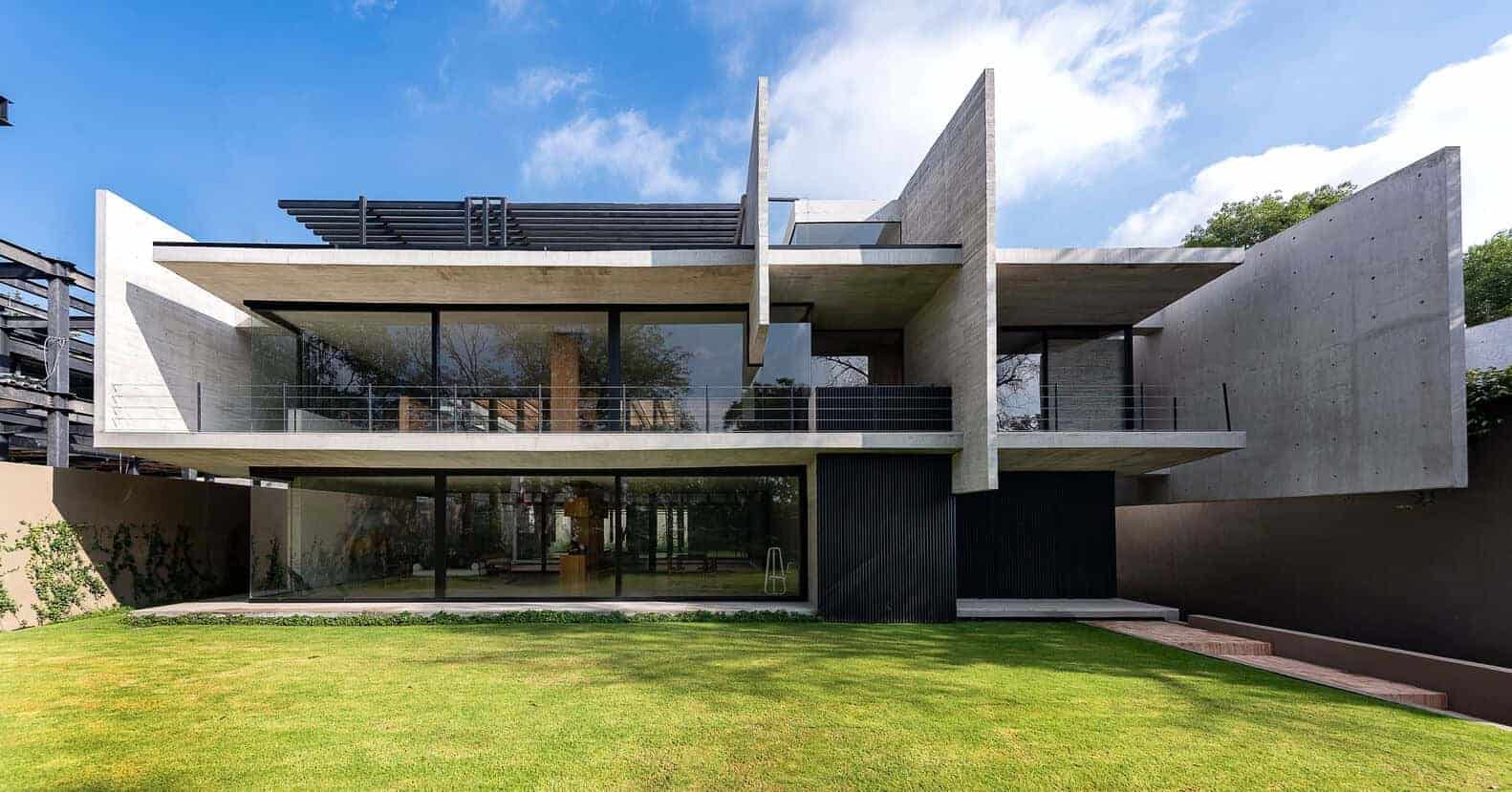
- Project: Casa Patios
- Architect: Ricardo Yslas Gamez Arquitectos
- Location: Mexico, Mexico City
- Year: 2023
- Area: 1200 m2
- Photography: Jaime Navarro
A Tree, Two Volumes & Courtyards: The House as Living Ecosystem
In this ambitious residence in Mexico City, Ricardo Yslas Gámez Arquitectos craft a narrative architecture where nature, volume and movement coalesce into one fluid experience. Casa Patios embraces an existing 70-year-old guava tree—transplanted from Morelia—as the prime organizing element of the home. The architects did not simply design around the tree; they placed it at the core of the residence, creating a dialogue between living architecture and living nature.
The house is composed of two main volumes connected by a bridge that straddles two strategically placed courtyards. These courtyards define the architecture’s rhythm: the larger primary patio houses the tree and becomes the spatial heart, while the secondary courtyard serves as an outdoor dining terrace linked directly to the kitchen. Through this choreography of spaces, the home creates transparency at ground level, visual connection across volumes, and natural cross-ventilation that responds to Mexico City’s climate.
Spatial Strategy & Architectural Logic
From the start, the design set forth intentions both subtle and powerful. One key intention: the ground floor should allow views across the entire site, allowing the inhabitant to experience the breadth of the lot rather than feel constrained. The two volumes extend in parallel, joined by a bridge, one volume housing social functions (living, dining, game room) and the other housing private zones above. The courtyards act as intermediate spaces—not simply gaps between buildings, but active components of the spatial sequence.
The bridge that connects the volumes introduces an elevated pedestrian link, and allows the architecture to hover above the courtyards and gardens. Meanwhile the material palette—concrete slabs, large glass walls, floating elements—gives the structure a sense of weight and lightness simultaneously.
Materiality, Light & Nature
Concrete emerges as the primary material—bold, honest, sculptural. The slab-floors and floating concrete elements of the master bedroom express structural clarity while reducing visual clutter. Glass walls dissolve boundaries between inside and out, allowing the gardens and patios to become extensions of the living spaces. Light filters through via open courtyards and elevated bridges, creating dynamic light and shadow across surfaces.
The decision to preserve the guava tree as the central living entity speaks to the house’s ecological and cultural intelligence. The tree anchors the social area, bringing nature into everyday life rather than it being a background. Gardens, courtyards and volumes interweave—blurring lines between architecture and landscape.
Living Experience: Transparency, Movement & Structure
Walking through Casa Patios is to move through an unfolding spatial sequence: you enter, pass through the primary courtyard with the tree, arrive at the open social volume with views to the garden; you cross the bridge into the second volume, climb to the private suites—floating slabs and concrete planes defining the master floor. Each direction offers view and interior-exterior connection, each shift in volume or level introduces tactile and visual variation.
The architecture is generous at scale (1,200 m²) yet finely composed—never ostentatious, but always intentional. Privacy is achieved not by isolation but by volume, direction and mediation via courtyards and bridge.
Why Casa Patios Matters
-
Integration of nature and architecture. The conscious preservation of the tree as the organizing axis elevates the project into a narrative of life, time and architecture.
-
Spatial complexity without chaos. Two volumes, two courtyards, a bridge—they could easily become confusing, but here they are composed with clarity, legibility and elegance.
-
Climate and comfort intelligence. The courtyards, transparency, cross-ventilation respond to local climate with natural strategies rather than relying solely on mechanical systems.
-
Material honesty and scale. The concrete slabs, glass walls and garden volumes create presence and durability without resorting to architectural theatrics.
Casa Patios achieves a rare blend: a large-scale residence that feels grounded, human-centered and intimately connected to its site.


