
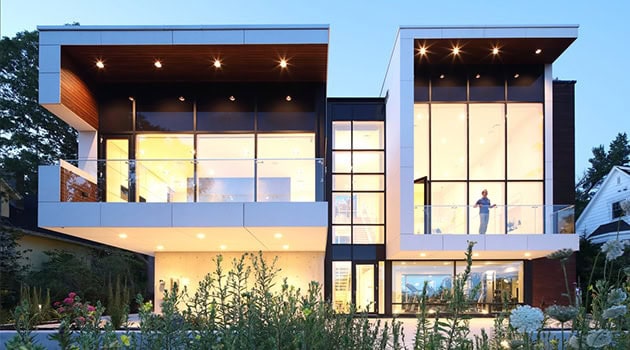
- Project: Syncline House
- Architect: Omar Gandhi Architect
- Location: Canada, Halifax
- Year: 2017
- Area: 474 m2
- Photography: Ema Peter
Syncline House by Omar Gandhi Architect is a bold contemporary residence located in the south end of Halifax, Nova Scotia. Built on the city’s only syncline—a rare geological fold in stratified rock—the home embodies both the strength of its rocky foundation and the elegance of modern architecture.
Designed for clients Geoff and James, the house seamlessly integrates minimalist design principles, innovative materials, and expansive views of Point Pleasant Park and the Northwest Arm inlet. The result is a quiet yet powerful coastal retreat that reflects both resilience and refined living.
Site & Geological Inspiration
The name “Syncline” itself comes from geology, referencing a fold in rock layers where younger strata sit at the center. The house is uniquely positioned on Halifax’s lone syncline, and this rare setting directly influenced the architecture.
Sitting on a robust concrete base that extends the natural rocky formation, the home emerges as an organic continuation of the terrain. This geological connection is mirrored in the home’s strong massing and interplay of volumes, which feel grounded yet dynamic against the Atlantic horizon.
Architectural Composition – Twin Volumes & Central Atrium
The residence is structured as two distinct white-clad volumes, connected by a double-height glazed atrium:
-
The taller volume contains the public program — gym, kitchen, and living room — elevated for maximum views of the ocean.
-
The lower volume holds the more private functions — bedrooms, offices, and intimate spaces.
-
Walk-out decks extend from both wings, providing outdoor living opportunities that capture panoramic views of the sea and Point Pleasant Park.
-
Atop the volumes, wood-decked patios create rooftop sanctuaries where occupants can experience the forest and ocean simultaneously.
The home’s central core is fully glazed, with a razor-thin canopy roofline sheltering a porous, wood-lined steel staircase that winds upward through the atrium. This striking feature ties together the twin masses while allowing natural light to flood the interiors.
Materials – Robust and Refined
The exterior is clad in white Fibre C panels, a German-engineered fibre cement made of sand, glass fibre, and cement. This material was chosen for its durability, clean lines, and tactile surface texture, reinforcing the home’s modernist character.
Complementing the sleek white panels is a scorched spruce wood element. Locally sourced spruce was intentionally charred, brushed, and sealed, creating a rich black finish that is both decay-resistant and fire-resistant. This treatment adds warmth, texture, and durability to the façade while referencing traditional Japanese shou sugi ban techniques.
Inside, the palette is kept minimal and bright:
-
Wide-plank white oak flooring grounds the spaces.
-
All-white walls and floor-to-ceiling headerless doors emphasize simplicity.
-
Expansive glazing provides uninterrupted light and views, while automated blinds ensure comfort.
Interiors – Light, Space & Connection
The interior design is minimalist yet welcoming, relying on material warmth and abundant daylight rather than ornamentation. Key features include:
-
A double-height great room with expansive glazing.
-
A wood-lined central staircase, serving as both a functional and sculptural element.
-
Fluid transitions between interior and exterior spaces, maximizing the connection to the ocean and surrounding forest.
Natural light plays a central role, with the atrium and carefully positioned windows orchestrating patterns of light and shadow throughout the day.
Sustainability & Energy Efficiency
Syncline House is designed with a deep commitment to sustainability, incorporating both passive and active strategies:
-
Geothermal heat pumps provide efficient heating and cooling.
-
A rooftop solar photovoltaic array supplements energy needs.
-
Triple-pane glazing enhances insulation and reduces noise.
-
Passive cooling strategies include recessed southwest-facing windows and automated blinds.
These design choices reduce energy consumption and create a comfortable year-round environment while minimizing environmental impact.
Syncline House by Omar Gandhi Architect is more than a striking coastal residence—it is a dialogue between geology, architecture, and human habitation. By embracing Halifax’s rare syncline formation and framing views of both the forest and ocean, the house becomes a modern sanctuary that is at once resilient, sustainable, and deeply connected to its site.
This project exemplifies Omar Gandhi Architect’s ability to balance innovation, context, and craftsmanship, resulting in a home that is timeless, functional, and poetic in its relationship with the land and sea.


