
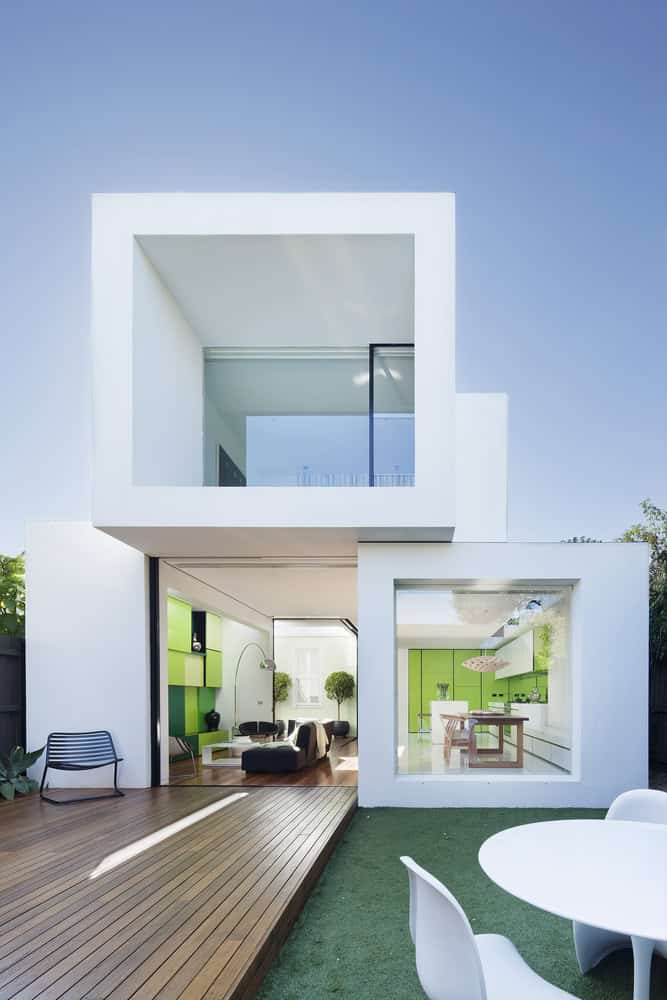
- Project: Shakin' Stevens Residence
- Architect: Matt Gibson Architecture
- Location: Australia, Melbourne
- Year: 2016
- Area: 200 m2
- Photography: Shannon McGrath
Matt Gibson Architecture + Design transformed a modest Victorian workers’ cottage in Richmond, Melbourne into a striking example of modern Australian residential design. Known as the Shakin’ Stevens Residence, the 2,152-square-foot project merges heritage with bold contemporary forms, balancing sustainability, functionality, and color in a compact urban setting.
A Heritage Front, A Modern Heart
From the street, the cottage maintains its traditional Victorian façade, aligning with the historic neighborhood fabric. But behind its modest frontage lies a radically modern addition, defined by three white extruded cubes that appear as though they have been scattered like dice behind the heritage house.
These new forms host separate functional zones—living, dining, and sleeping—while maintaining a clear programmatic identity both inside and out.
Concept of Flow and Green Connection
The design responds directly to the client’s desire for connection to green space rather than simply more square footage. The architects prioritized:
-
Light-filled interiors with visual extensions into gardens.
-
Soft spatial delineation that avoids rigid compartmentalization.
-
Green highlights that work in harmony with the surrounding garden.
The result is a home that dissolves the boundaries between interior and exterior, blurring architecture with landscape.
For related projects, see Modern Home Extensions in Australia.
White and Green Interior Strategy
The interior palette is predominantly white, serving as a neutral backdrop for the client’s chosen highlight color: green. Green became a natural choice, linking the design directly to the garden while reinforcing the project’s identity.
Lighting and openings were carefully orchestrated so that the white cubes act as frames for greenery, both inside the house and beyond its boundaries.
Sustainability Principles
Shakin’ Stevens Residence integrates extensive ESD (Environmentally Sustainable Design) strategies, including:
-
Retention of the existing structure
-
Optimal orientation for solar control
-
Passive temperature regulation with exposed thermal mass
-
Insulation of walls, floors, and ceilings
-
Recycled timber flooring and decking
-
Greywater system and dual water storage tanks
-
Low embodied energy construction techniques
Even planting choices, including succulents and artificial grass, were made with water conservation in mind.
This approach ensures the house is not only contemporary in design but robust and sustainable for the future.
Flexible and Future-Ready Living
The layout is adaptable, accommodating multiple user types: couples, families with teenagers, or multi-generational households. Separate sleeping zones are organized around a flexible living area, which can expand into outdoor spaces when needed.
By prioritizing amenity over size, the Shakin’ Stevens Residence offers a sustainable model for compact urban living that remains responsive to changing family dynamics.


