
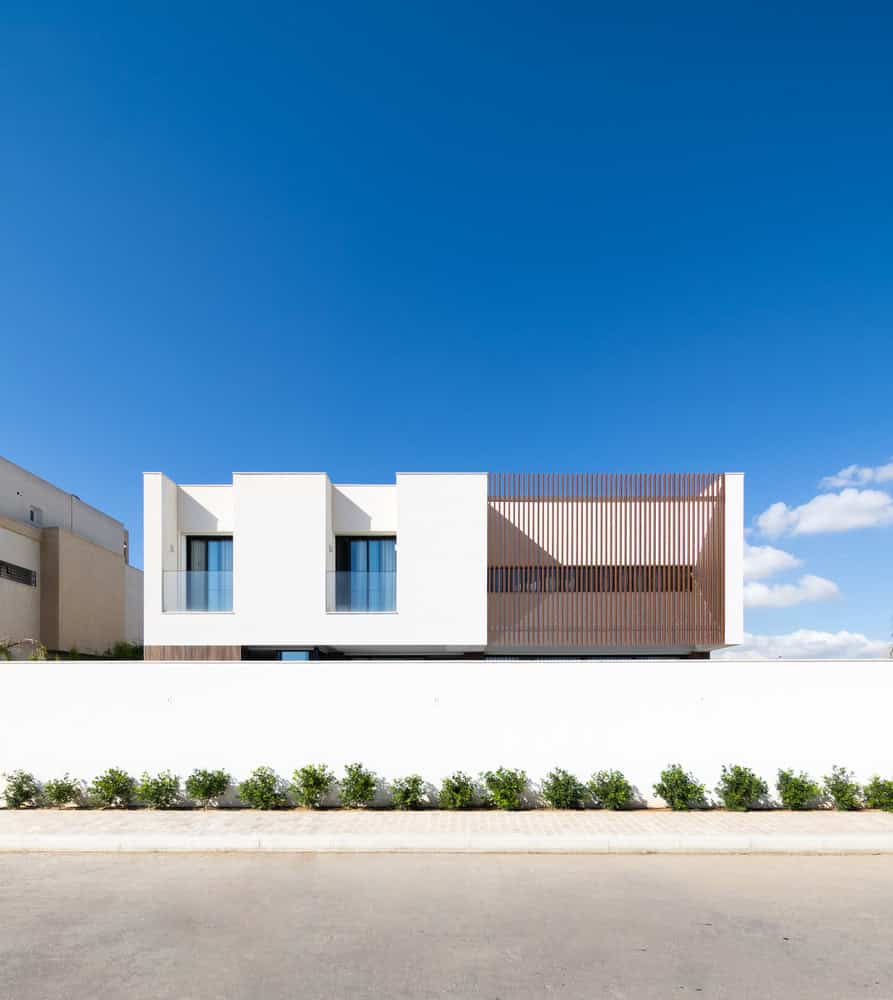
Villa H / ARK-architecture / Tunisia

  • Project: Villa H
  • Architect: ARK Architects
  • Location: Tunisia, Tunis
  • Year: 2025
  • Area: 620 m2
  • Photography: Bilel Khemakhem
Villa H street corner view by ARK-architecture in Tunis, Tunisia
Photography © Bilel Khemakhem
Villa H street elevation by ARK-architecture in Tunis, Tunisia
Photography © Bilel Khemakhem

In the densely woven residential landscape of Tunis, Villa H by ARK-architecture emerges not just as a residence, but as a refined architectural statement — a delicate negotiation between intimacy and openness, and a masterclass in spatial clarity, material precision, and Mediterranean light. Designed to optimize a compact urban site while preserving a sense of calm, this 620 m² villa achieves a harmonious balance of privacy, landscape integration, and modern domestic life.

From the approach, Villa H is intriguingly reserved. A muted, almost silent street façade deflects the urban context, employing thoughtful restraint rather than grandiosity. Within this quiet exterior, privacy reigns, punctuated by a slender olive-green steel canopy that elegantly marks the entrance, creating a transition from public to private life with both clarity and grace.

Villa H entrance gate by ARK-architecture in Tunis, Tunisia
Photography © Bilel Khemakhem
Villa H entrance approach by ARK-architecture in Tunis, Tunisia
Photography © Bilel Khemakhem
Villa H side elevation by ARK-architecture in Tunis, Tunisia
Photography © Bilel Khemakhem
Villa H wooden screen facade detail by ARK-architecture in Tunis, Tunisia
Photography © Bilel Khemakhem

Once inside, the architecture reveals its true narrative: a choreography of light, air, and spatial connection. Organised across three levels, the design allows the house to breathe despite its compact footprint. The basement houses technical amenities and leisure spaces alongside parking — an intelligent allocation that liberates the upper floors for living and repose. Above, the ground floor unfolds into a generous garden and a linear pool, their juxtaposition blurring the boundary between architecture and landscape.

Villa H swimming pool daytime view by ARK-architecture in Tunis, Tunisia
Photography © Bilel Khemakhem

The garden and 11-meter pool serve as the emotional heart of Villa H. Clad in the same sandstone finish as the surrounding terrace, the pool appears carved from the ground itself, dissolving conventional separations between built form and nature. It is here — where water, material, and geometry converge — that Villa H articulates its most powerful architectural gesture.

Villa H poolside daytime view by ARK-architecture in Tunis, Tunisia
Photography © Bilel Khemakhem
Villa H swimming pool steps detail by ARK-architecture in Tunis, Tunisia
Photography © Bilel Khemakhem
Villa H pool with architectural overhang by ARK-architecture in Tunis, Tunisia
Photography © Bilel Khemakhem
Villa H pool shadow detail by ARK-architecture in Tunis, Tunisia
Photography © Bilel Khemakhem

A central double-height patio draws daylight deep into the core of the house, redefining vertical circulation as an experiential space. Inspired by the traditional courtyards of North African architecture, this void introduces air, natural light, and a sense of continuity throughout the interior, but reinterprets it through a contemporary lens of minimalism and spatial fluidity.

Villa H double height interior by ARK-architecture in Tunis, Tunisia
Photography © Bilel Khemakhem
Villa H interior wooden screen by ARK-architecture in Tunis, Tunisia
Photography © Bilel Khemakhem
Villa H living room daylight view by ARK-architecture in Tunis, Tunisia
Photography © Bilel Khemakhem
Villa H kitchen and dining area by ARK-architecture in Tunis, Tunisia
Photography © Bilel Khemakhem

The upper level — home to four sunlit suites — illustrates an intimate dialogue with both light and landscape. Carefully positioned openings frame views and harness daylight, while maintaining privacy and comfort. This thoughtful orchestration of apertures and overhangs not only enhances spatial experience but also reinforces passive environmental performance, nurturing a living environment responsive to Tunis’s Mediterranean climate.

Inside, spatial adaptability is central to the design ethos. A movable wooden partition between the living and dining zones allows fluid reconfiguration of the ground floor, responding to the dynamic needs of modern family life without expanding the footprint. This subtle strategy elevates functional flexibility while preserving architectural purity.

Materiality in Villa H is deeply rooted in context. Hollow clay brick walls and Kadhel marble flooring amplify and diffuse Mediterranean light, while crisp white plaster surfaces provide a luminous, serene backdrop. Warm wood accents balance precision with comfort, introducing a tactile depth that complements the overall calm aesthetic. At the entrance, an olive tree — emblematic of Mediterranean resilience — frames the home’s narrative of rooted simplicity and timeless elegance.

Villa H swimming pool night view by ARK-architecture in Tunis, Tunisia
Photography © Bilel Khemakhem
Villa H illuminated facade at night by ARK-architecture in Tunis, Tunisia
Photography © Bilel Khemakhem

What sets Villa H apart in contemporary residential architecture is not merely its spatial finesse or material richness, but its capacity to redefine how compact urban homes can perform. Here, architecture becomes an act of calibration — of light with shade, openness with privacy, and modern form with contextual resonance. Villa H is more than a dwelling; it is an architectural meditation on serenity and space in the heart of the city.

Villa H south-east elevation by ARK Architecture, Tunisia
Villa H north-east elevation by ARK Architecture, Tunisia
Villa H section B-B by ARK Architecture, Tunisia
Villa H section A-A by ARK Architecture, Tunisia
Villa H ground floor plan by ARK Architecture, Tunisia
Villa H first floor plan by ARK Architecture, Tunisia
Villa H underground floor plan by ARK Architecture, Tunisia
Villa H axonometric diagram by ARK Architecture, Tunisia

Posted by ARK Architects

ARK Architects is a boutique architectural firm renowned for delivering exceptional luxury residences that seamlessly integrate nature, materials, lifestyle, and innovation. Founded on the belief that “architecture is a built idea,” ARK transforms visions into timeless homes that are as emotionally resonant as they are architecturally precise. For over 25 years, ARK Architects has specialized in the design and construction of bespoke single-family villas in some of the most prestigious locations in Europe, including Marbella, Sotogrande, and La Zagaleta. Each project is crafted as a unique architectural masterpiece, a tailored living experience where sustainability, high performance, and aesthetic excellence converge. The firm is led by three visionary partners—Manuel R. Moriche, Santiago Ruiz, and Diego Suárez—who bring together a shared passion for holistic design. At ARK, architecture is not just a service; it’s a journey. Clients are invited to participate in a collaborative creation process from the very beginning, dreaming alongside architects to shape a home that reflects their deepest aspirations. With an in-house team that includes architects, interior designers, engineers, and sustainability experts, ARK delivers a global solution: from the first sketch to the final construction detail. The firm is committed to using natural materials—stone, wood, textiles—and the latest in sustainable and smart home technologies to create residences that are living ecosystems, finely tuned to their environment and inhabitants. Every ARK home is a response to its context—a balance between innovation and tradition, intimacy and openness, comfort and sophistication. The result is more than a house; it’s a sanctuary. A place where clients find harmony, peace, and a sense of belonging that transforms the way they live. ARK Architects continues to redefine luxury architecture by fostering a laboratory of ideas—constantly evolving to embrace the newest methodologies, construction techniques, and environmental strategies. Their mission is clear: to build homes that are not only works of art but also enduring assets, spaces where human experience is elevated through thoughtful, inspired design.