
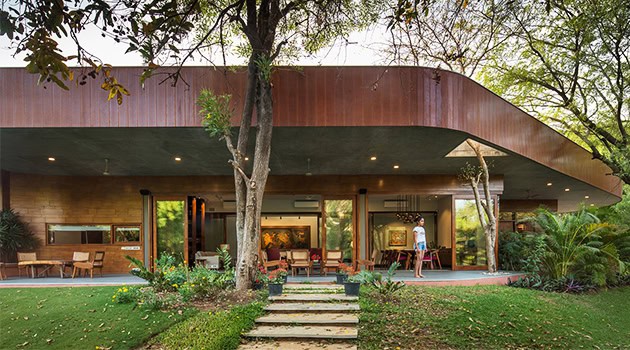
- Project: Verandah House
- Architect: MODO Designs
- Location: India, Ranchodpura
- Year: 2015
- Area: 630 m2
- Photography: Bharat Aggarwal
On the outskirts of Ahmedabad, India, surrounded by dense flora and a serene lily pond, stands Verandah House, a contemporary residence by Modo Design. Spanning 6,781 sq ft, this single-story dwelling reinterprets the image of a colonial ancestral home through fluid curvilinear forms, semi-open verandahs, and a seamless connection with nature.
Built for the Munshaw family on a 4-acre estate, the house was envisioned as a permanent retreat away from the crowded city. The client’s brief was clear: avoid a box-like form, create a home that celebrates outdoor living, and design a container for a lifetime’s collection of artifacts, books, Persian rugs, and ancestral furniture.
Concept & Inspiration: A Contemporary Colonial Echo
Verandah House reimagines the Munshaw family’s old colonial residence, translating its essence into modern architectural language. The house bends and curves to respond to the lily pond and the natural wilderness of the site, introducing element of surprise in its spatial experience.
The design is anchored by expansive verandahs:
-
Entry verandah – welcoming guests with views toward the garden.
-
Lower verandah – a shaded extension of living areas.
-
Upper verandah – hovering 15 feet as a cantilever, fusing architecture with the landscape.
These verandahs embody the lifestyle the owners sought: semi-open transitional spaces for gathering, resting, and enjoying the outdoors.
Spatial Organization: A House of Courts and Spines
The home’s layout is organized around a central spine illuminated by skylights and flanked by distinct functional zones:
-
Garden-facing bay: Living room, dining area, library, and master bedroom—all with views of the main garden and pond.
-
Rear bay: Kitchen, mother’s room, and daughter’s room, interspersed with landscaped entry courts and a central court that bring light and greenery deep inside.
This dual-bay strategy ensures privacy for bedrooms while keeping common areas open and transparent.
The master bedroom and daughter’s room are elevated to enjoy broader views across the garden, while the central court becomes the soul of the house—inviting daylight and greenery into the interiors.
Materiality & Atmosphere
The material palette merges raw outdoor character with refined interiors:
-
Exteriors: Natural jute panels wrap the curving beam faces; Valsadi wood is used for paneling and doors; concrete ceilings and terracotta-colored surfaces reinforce rustic authenticity.
-
Flooring: Rough Kotah stone floors in semi-open areas contrast with polished Kotah stone inside.
-
Furniture & artifacts: Old wood and cane furniture, carefully renovated, fills verandahs, while interiors showcase Persian rugs, paintings, and antiques—bridging heritage and modernity.
-
Contrast: Interiors are light, white, and polished, while verandahs retain earthy, textured finishes.
This careful balance creates a dialogue between past and present, between wilderness and domestic comfort.
Lifestyle & Living Experience
Verandah House is designed as a container of memories and a stage for contemporary living:
-
The verandahs act as social spaces for gatherings, offering shaded retreats throughout the day.
-
Courtyards and skylights ensure the interiors remain naturally lit and ventilated, reducing reliance on artificial systems.
-
The house flows organically, reflecting a lifestyle rooted in openness and connection to nature.
Architectural Significance
The Verandah House is more than a residence—it is a manifesto for how modern Indian homes can reinterpret colonial heritage while staying grounded in site, culture, and lifestyle.
-
Curvilinear form responds to natural features and avoids rigid geometry.
-
Verandahs reinterpret colonial semi-open spaces as modern lifestyle elements.
-
Courtyards and spines create light-filled, breathable interiors.
-
Material palette blends rustic rawness with refined elegance.


